IN DEPTH
WHAT HAPPENS BETWEEN THE CALL AND THE TAKEOFF
The passenger sees a ready cabin and a car on the ramp. Behind it were eighteen hours of invisible work.
It's three in the afternoon and a request comes in: an executive jet needs to leave Cancún (MMUN) for Bogotá (SKBO) tomorrow at seven. For the client, it's a single sentence. For whoever coordinates it, it's the starting gun of a race against the clock the passenger will never see. It's worth telling, because in that gap, between the sentence and the wheels in the air, lives the whole craft of flight support.
The first thing to move is the regulatory framework. An international flight crosses skies that aren't its own, and every country under the route has to authorize it: overflight permits to pass through, a landing permit to touch down. And the requirements change with the type of operation, private general aviation (Part 91) isn't the same as commercial charter (Part 135), so you validate, FIR by FIR (each flight information region along the way), what each state demands. Some permits come through in hours; others take business days. This time the clock gives no slack, so you prioritize and start calling.
In parallel, ground coordination begins. Is parking and an overnight slot available at that hour at El Dorado? Does the airport want a slot or a prior PPR? Each question is a different provider, the FBO receiving the aircraft, the ground power unit (GPU), cabin cleaning, catering, all in different time zones, and all of them have to line up on the same estimated time of arrival (ETA).
Good flight support shows, above all, in what doesn't happen: the surprise that never came.
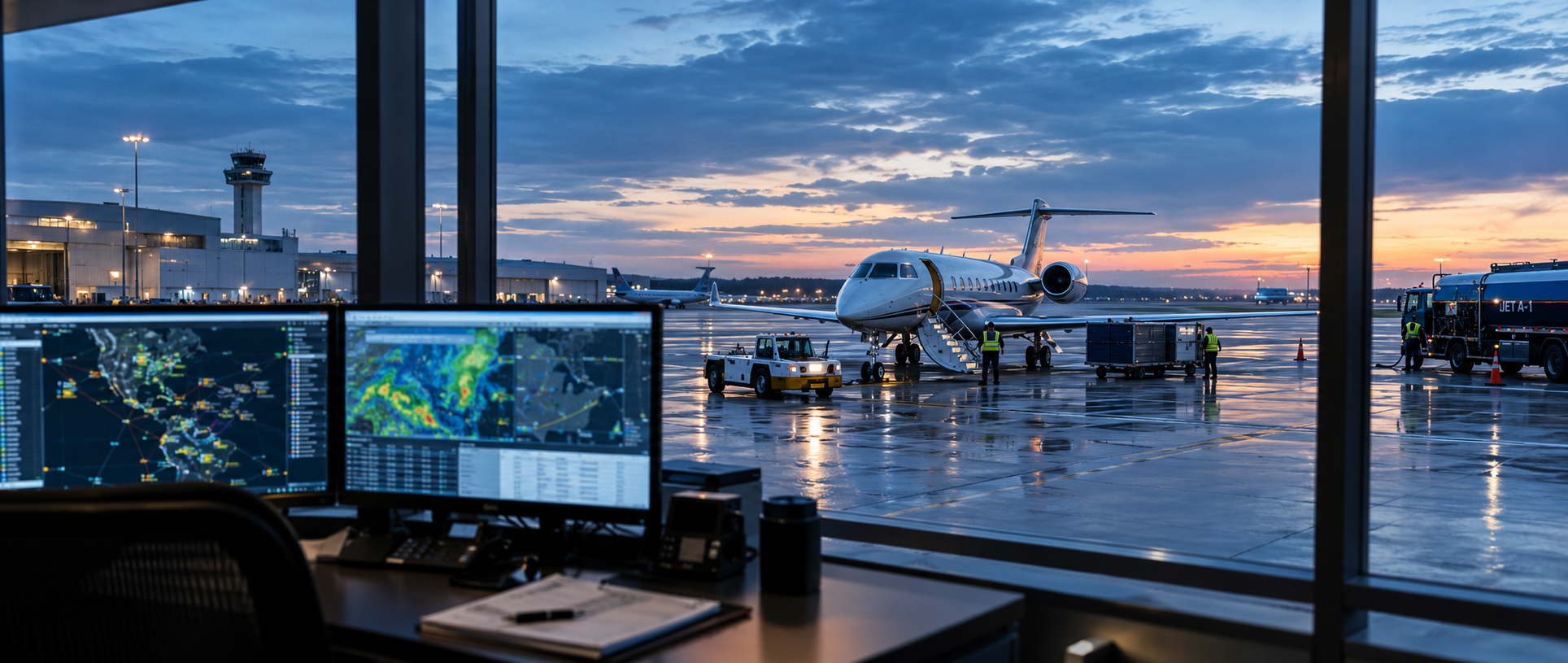
Before the doors close, passenger and crew data has to be filed through APIS to the immigration authorities at both origin and destination, with the General Declaration (GENDEC) in order. A mistyped field or an unstamped document can hold the aircraft on the ramp or bring a fine.
And there's fuel, which is no small detail: you confirm Jet A-1 is available, arrange the Fuel Release to secure credit on the ramp, and calculate the optimal load, factoring in alternates and en-route weather.
None of this is visible to the passenger. At seven in the morning they arrive, find a courtesy car waiting, step into a spotless cabin and depart on time. It feels simple. And that simplicity is, in fact, the finished product of work that consisted, above all, of making sure not one of the ten things that could go wrong did. Coordinating all those threads from a single point of contact, so the client has one conversation, not ten, is exactly what a flight-support provider does.
Frequently Asked Questions
Can't a pilot or flight department handle all this directly?
For simple domestic flights, yes. But on international operations, multiple FIRs, shifting APIS requirements and local providers at every stop, centralizing the logistics with a flight-support provider optimizes costs, prevents delays and lets the crew focus on the one thing that matters on board: the safety of the flight.
How is an FBO different from a flight-support provider?
The FBO is the private terminal at a specific airport. The flight-support provider coordinates the whole route end to end: government permits, fuel releases, crew logistics and ramp services at each stop on the itinerary.
How far in advance should an international operation be coordinated?
As soon as the itinerary is confirmed. Landing permits at congested airports and slot or parking reservations are the sector's main bottlenecks.
What happens if a permit doesn't come through in time?
The flight doesn't go. Without overflight or landing authorization, the aircraft stays on the ground until it's resolved, with the cost and rescheduling that entails. That's why arranging permits ahead of time is the heart of flight support, not just another formality.
Is flight support only for international flights?
No. Its value is clearest when borders are involved, but it also coordinates complex domestic operations: congested airports, multiple stops,
fuel at uncertain destinations or crews that need logistics. The principle is the same, one point of contact that handles the entire operation.

